Understand workflows, flows, and steps
Imagine an incoming support email. You need to identify its request, collect relevant facts, and prepare a response—or ask a person to review it. Foliqant organizes that process into a workflow, its flows, and their individual steps.
Your application sends one input and awaits one result. The process runs in memory, using only the routes and operations you defined.
Map the business process
Use the three runtime levels deliberately:
| Level | Represents | Owns |
|---|---|---|
| Workflow | One capability invoked by the application | Public input, starting flow, graph, final payload |
| Flow | One sequential business boundary | Resolved input, ordered steps, result projection, next route |
| Step | One atomic unit of model, tool, or trusted code work | Selected input, instructions, schema, typed result |
A workflow may contain one flow or route across several. A flow may contain one or more ordered steps. Steps never select the next flow; the containing flow owns transitions and unresolved handling.
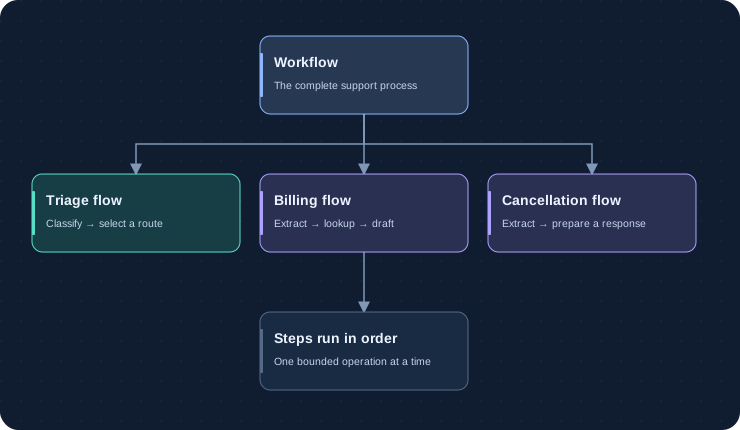
The diagram shows ownership. The process below shows how a configured route selects the next flow. Both routes and step order are defined by your application.
flowchart TD
    accTitle: A workflow contains flows, and flows contain ordered steps
    accDescr: An intake workflow starts with a classification flow. Its authored transition selects a billing flow with extraction and Python validation steps, or returns a review outcome. Unresolved classification also returns review.
    subgraph workflow["Workflow: handle a request"]
        direction TB
        subgraph classify["Flow: classify"]
            direction TB
            intent["Step: decision — identify intent"]
        end
        intent --> route{"Classification flow's transition"}
        route -->|Billing| extract
        subgraph billing["Flow: billing"]
            direction TB
            extract["Step: llm — extract invoice fields"]
            extract --> check["Step: handler — apply business rules"]
        end
        route -->|Other result| review["Outcome: needs_review"]
        intent -.->|Unresolved handling| review
        check --> done["Outcome: completed"]
    end
This illustrative process uses three of the five step types. A declared mcp
step can read from an external tool; a flow_collection step can collect work
from callable flows. The diagram's arrows between flows represent authored
transitions, not model-generated instructions. The completed path assumes the
billing steps succeed; validation and execution failures remain visible in the
result rather than becoming a successful business outcome.
Choose a new flow when the process needs a separately testable boundary, a route, or explicit review handling. Choose another step when work remains in the same sequential boundary but needs a different input, schema, provider, tool, or trusted handler.
For a reviewed list of independent items, a flow_collection step can invoke
allowlisted callable flows sequentially. A trusted planner must produce each
item's ID, callable flow, and complete child input. Callable flows have no graph
transition and cannot become the workflow start or route targets. The collection
returns an ordered child ledger so final policy can consider completed, review,
failed, and skipped work together.
Compile, open, and run
prepare_application reads strict local configuration, resolves definitions
and schemas, checks graph and binding references, validates declared provider
capabilities, and freezes the compiled resources. It does not read .env, open
network clients, or execute the workflow.
open_application resolves marked environment fields and opens configured
clients. Keep that async context open while the host accepts work. Call
application.run(workflow, envelope) for normal business execution.
run_flow and run_step accept already-resolved boundary input and are useful
for focused tests and evaluation.
Every call runs in the foreground. Admission limits bound work inside one process; they do not create persistent jobs. The host owns transport, authentication, rate control, idempotency, and result storage.
Pass selected context
Bindings copy explicit JSON values from the current boundary. A step receives only its declared input. Each model step starts a fresh conversation; prior prompts, messages, and envelope fields are not forwarded implicitly.
Within a flow, bindings to earlier steps use /steps/{step}/.... Workflow
routes and output projections use /flows/{flow}/.... The public result places
step records under /flows/{flow}/steps/{step} and exposes a projected workflow
value at top-level payload.
Keep authority separate from data
Instructions, decision questions and criteria, schemas, routes, and tool allowlists are authored policy. Bound source values, metadata, prompt substitutions, and prior model or tool results are data. The model adapters state this boundary explicitly, while still permitting an authored task to classify, extract, transform, or quote instruction-like text.
Runtime validation and scoped tool authorization remain required. Prompt policy alone cannot prove that every provider will follow the boundary. Use reviewed adversarial cases when the business process handles untrusted text.
Treat unresolved results as process state
Each decision result reports answerable, partially_answerable,
not_answerable, or undetermined, with stable issue codes and evidence strength.
A validated fallback may supply a
separate process selection for a single-choice question, but it does not rewrite
the native answer.
Flows route unresolved work explicitly through on_unresolved; it cannot fall
through to a successful downstream action. The public result keeps transitions,
native observations, fallback selections, and terminal status available for
review.
See Inputs, results, and errors for the complete public shapes and the distinction between an unresolved decision and an execution failure.
Continue with workflow authoring, then add reviewed evaluation cases at the full pipeline and any useful flow or step boundaries.